(Editor’s Note: This blog post is about the historical portrayal of unhoused populations. This post shares and explains the terms used through a historical lens. We do not endorse using derogatory terms to refer to any group of people.)
About a third of the way into The Grapes of Wrath, Tom Joad, newly arrived in California with his family, asks a man what the word “Okie” means. The man tells him it used to mean you were from Oklahoma, but now it means you are dirty. Steinbeck published The Grapes of Wrath in 1939. The Joads headed west after losing their farm to a drought and the bank. By the time they crossed the California state line, they’d been renamed, and that name came with a terrible set of assumptions. Almost a hundred years later, when most picture an unhoused individual, the image is more modern, but the assumptions remain the same.
Before The Joads: The Original Portrait
Before the terms homeless or unhoused, people used other terms to describe individuals without homes. After the Civil War, both workers and soldiers formed a wandering workforce that the media portrayed as a panic, labeling these men as “the tramp evil.” The word tramp became a threat; it was a man who did not work and threatened peace by stealing. A tramp was defined as a man who did not work and actively avoided employment. In the late 1890s, linguist H.L. Mencken further divided the unhoused of the time into three categories: the tramp, the hobo – a traveling laborer, and the bum -a stationary unhoused worker who often had a connection to a substance use disorder.
In the media of this time, this is how the unhoused were portrayed. Then the Great Depression painted a different picture in the media.
The Depression: Displaced and Blamed for It
By 1933, an estimated 1 to 3 million Americans were unhoused, or transient. Many were not single men as described before; they were often families from the plains, pushed off their land by an ecological disaster and financial depression. Many went west in search of work. Steinbeck followed them in a series of newspaper articles he wrote prior to writing The Grapes of Wrath. In 1939, The Grapes of Wrath was the best-selling novel, and a year later a film was made based on it.
The Post War Joke
After WWII, the economy, workforce, and culture changed. Unhoused men became a popular joke. Characters like Emmett Kelly’s Weary Willie, a sad-faced clown, rose in popularity, and Red Skelton’s Freddie the Freeloader also rose wildly in popularity during this time. Soon, cartoons depicted hobos in tattered, patched trousers hopping trains and carrying a sack tied to a stick called a brindle.
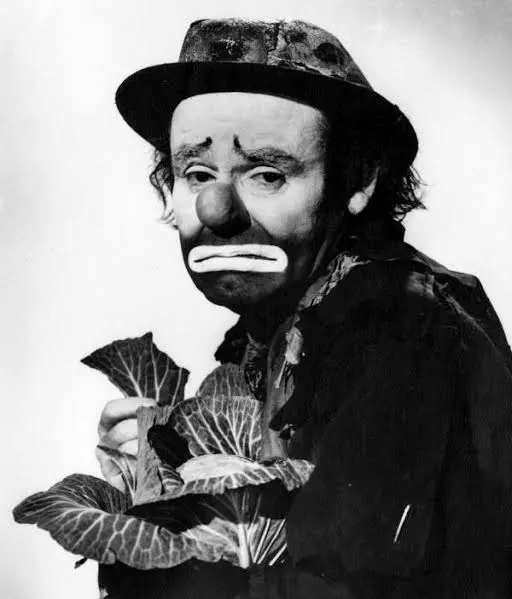
This is the character of Weary Willie, a popular idea of an unhoused man of the time.
While these characterizations were gentle, they still were not kind. But the idea of the unhoused man was once again in vogue; gone was the image of a man and his family. He was portrayed as a man who chose this life. This characterization remained for decades.
A Much Darker Picture
For most of the twentieth century, a person on a limited income could rent a single room. Single-room-occupancy hotels and boarding houses existed in just about every American downtown. In 1950s New York, more than 200,000 single-room-occupancy units existed. As cities modernized, many of these units were demolished to make way for larger living spaces. This happened across the U.S. through the 1970s and 1980s.
At the same time, many psychiatric hospitals closed on the promise of community care after years of accusations of abuse and wrongdoing. Now, many who were previously cared for and housed were unable to care for themselves and were unhoused, lacking the skills to obtain support and to gain and maintain housing.
For many, the rise in the unhoused population was dramatic. This is where the word “homeless” entered the American vocabulary. The image was no longer a friendly clown; it was the image of a “bag lady,” or someone experiencing significant mental illness. What didn’t change was the idea of choice. The common belief at the time was that individuals chose this lifestyle. The Center for Media and Social Impact measured modern television during this time and found that three out of every four storylines about the unhoused blamed the individuals, not the circumstances that led to the loss of housing. This decade set the script for the portrayal of the unhoused that is still repeated today.
The 2000s: The Rescue

Throughout the 1990s and early 2000s, Hollywood produced a series of “feel-good” stories about the unhoused. These stories focus on exceptional individuals and the person who “rescues” them. Examples include The Fisher King, With Honors, The Pursuit of Happyness, The Soloist, The Blind Side, and Same Kind of Different as Me. This portrays the unhoused as a genius or a wounded innocent, and they outshine others’ talent or strangers’ kindness. While these films gave the man on the bench a name and a backstory, they still did not reflect reality in most cases. Portrayals of unhoused families and single women were few and far between, while the face of homelessness remained male.
The 2020’s

In the 2020’s we are once again seeing better representation of unhoused women in media and families. Maid, a Netflix show, is a realistic representation of a woman fleeing domestic violence with her child. Kristin Hannah’s 2020 novel The Four Winds is another woman-led narrative about a woman fleeing west during the Great Depression. In 2020, the film Nomadland shows Frances McDormand as an older adult living in her van after the Great Recession. In this decade, we’ve also seen a handful of wonderful documentaries with true stories and greater representation of unhoused people, exploring the causes of homelessness without placing blame on the person.
Building a Stereotype Over Time
When we put the eras side by side, an image emerges. At first, it was a man; then, in 1939, he became a displaced family in The Grapes of Wrath. By the 1950s, the family was gone, and a lone man with a brindle had taken their place. By the 1980s, this man was no longer seen as funny but as someone experiencing a mental illness, whether that was true or not. In the late 1990s and 2000s, our single unhoused man had gained a backstory and a housed person to discover him, leaving the audience with a feel-good experience. Only in the past decade are we starting to see broader mainstream representation and the true causes of homelessness portrayed in the media. For decades, media portrayals taught many Americans that the unhoused is a single man who is living this way by choice and perpetuated the myth that there must be a substance use disorder or mental illness. This is where we kick off our series, looking at how the media is beginning to change the public perception of the unhoused in American society. We invite you to follow along.