

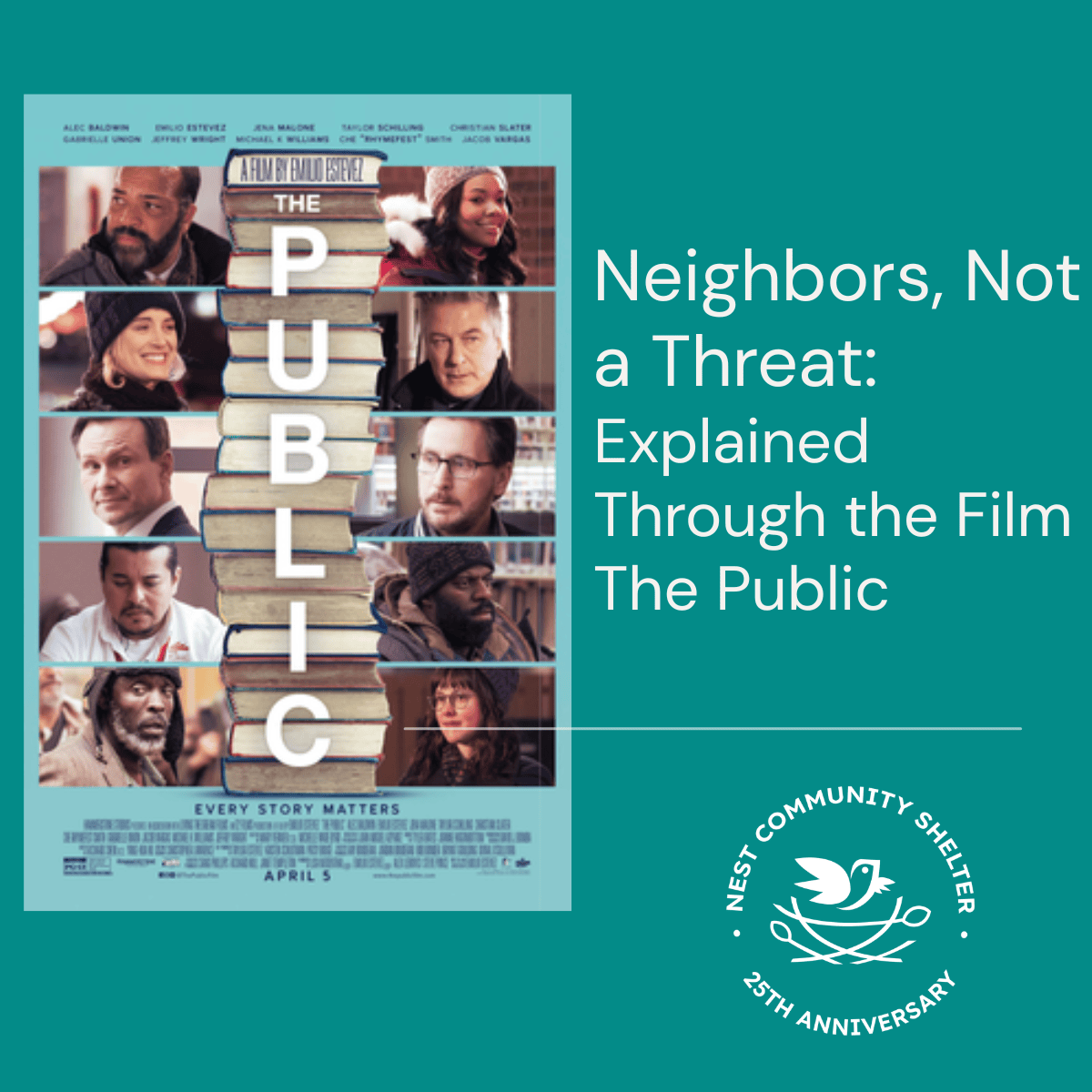
Next in our Unhoused in the Media series, we cover the film The Public, set against one deadly cold snap in Cincinnati and based on an essay written by librarians. This deeply moving film illustrates the life-and-death choices of those living on the streets, and those who meet them with dignity and understanding.
On a freezing morning in Cincinnati, the downtown public library opens its doors and welcomes the usual patrons. Some head to the restrooms to wash up before starting their day; others settle into their favorite reading chairs they’ve long claimed; a few stop by the desk to chat briefly with Stuart Goodson, the librarian who knows most of them by name. Emilio Estevez’s film, The Public, begins by capturing this everyday routine, emphasizing its ordinariness: people reading, using computers, staying warm inside a building that belongs to everyone.
Then the weather turns deadly cold. The city’s shelters are full, the temperature is falling to a point where no one can safely spend the night, and when closing time comes, a group of about seventy patrons, led by a veteran named Jackson, quietly decides not to go back out into the cold. They gather on the third floor and stay.
What makes this film stand out in our series is what happens next. Previous posts examined movies that depict homelessness from a distance, focusing on a single character’s struggle or a family’s journey. In contrast, The Public uniquely shows how the news frames the story of homelessness, letting viewers watch that narrative unfold gradually over one night.
Two stories about the same night
Inside the library, the night appears as it truly is: unhoused individuals sharing food, relaxing on the carpet between shelves, and waiting for dawn while shielding themselves from the harsh cold outside. Meanwhile, outside, a different scene unfolds. A TV reporter, Rebecca Parks, reports on a hostage situation, though no one is actually being held captive. Prosecutor Josh Davis, running for mayor, sees the headlines about the standoff as a chance to appear strong. Soon, riot gear-clad officers line the streets, turning a building full of people sheltering for their lives into something it isn’t.
The film centers on the disconnect between the media’s story and the reality inside the building: survival cloaked as a peaceful protest. This reflects a longstanding trend in popular culture. When homeless people show up in movies and news, they are typically portrayed in stereotypical roles: the misunderstood genius, the saintly figure offering a lesson, or the threat that must be managed. Among these, the threat is most emphasized, as fear often drives rapid, urgent coverage.
The research tells a quieter, sadder story. One of the largest studies of homelessness in decades, the University of California San Francisco’s 2023 California Statewide Study of People Experiencing Homelessness, surveyed nearly 3,200 adults and found that more than a third had experienced physical or sexual violence while without housing. The people sheltering in that library are very often the ones in danger, not the danger, and the film seems to understand this, even when the cameras outside do not.
A story that started in a real library
The concept of the Public did not emerge suddenly. On April 1, 2007, the Los Angeles Times featured an essay by Chip Ward, then an assistant director at the Salt Lake City Public Library, titled “Written Off: A Librarian’s Days Among the Chronically Homeless.” Ward depicted public libraries as “open, accessible, tolerant, and inviting” spaces, which is precisely why many neighbors with nowhere else to turn spend their days there. Estevez read the essay the morning it was published and recognized it would be his next film project. It took twelve years to bring this vision to the screen, and when it finally happened, filming occurred over twenty-two nights in January 2017 inside the Public Library of Cincinnati and Hamilton County, with some staff members appearing on camera as librarians and security personnel.
Libraries operated independently of Hollywood. In 2009, the San Francisco Public Library introduced the first full-time social worker in the U.S., Leah Esguerra, who helped patrons with housing, healthcare, and benefits. By 2022, data from Whole Person Librarianship showed 55 libraries with full-time social workers, about 122 hosting social work interns, and many more employing peer staff with lived experience of homelessness. Even before a camera crew arrived in Cincinnati, librarians nationwide were already tackling the film’s core question: what duties does a public building owe its community, especially those with nowhere else to go?
That question hits close to home. The librarians in our community see neighbors daily who are between homes, and they have become some of the most patient and practical helpers in town, guiding people to a warm place, a job application, or a phone number that could change their week. The Public is, in many ways, a tribute to them.
A familiar book on the third floor
Readers who have been following this series from the start will recall that it began with John Steinbeck and his 1939 novel, The Grapes of Wrath, which depicted Dust Bowl families forced onto the road. That same book appears again in The Public at a critical moment. During a tense phone call with the reporter, Stuart reads her a line about the people’s growing wrath, and she takes it as a warning from inside the building rather than a quote from one of the most widely studied American novels.
Though it’s a brief scene, it beautifully encapsulates the entire film within seconds. Almost ninety years after Steinbeck depicted families with no homes, those same words can be spoken to a journalist and sound threatening, depending on the speaker and their location.
Whose story is it?
Despite its warmth, The Public shares a common trait with many films in this series. Jackson and other patrons organize the sit-in, take risks, and confront the police. However, much of the film focuses on Stuart, the librarian who once lived on the streets and credits books with saving his life. His heartfelt story is a key element that makes the film compelling. Still, this perspective often means viewers see the patrons through his eyes rather than directly. Several critics pointed out that many characters are portrayed with a single defining trait, like a joke or quirk, rather than showing the full complexity of their lives, which the audience can only imagine.
How the night ends
Without revealing every detail of the ending, the standoff concludes not through violence but with music. As officers ascend the stairs, the patrons, in a peaceful protest, remove their clothes and sing “I Can See Clearly Now.” This moment, built throughout the night, turns a tense confrontation into something almost hymn-like. The ending carries a sentimental tone, which some reviewers felt was overly neat, but its message is clear: the threat the city anticipated all night never materialized.
We invite you to notice how much of the night is spent quietly, with people reading, resting, and looking after one another, and how little of that quiet ever makes it onto the television screens outside. Notice who is given a name and a history, and who is only ever part of the crowd. Listen for Steinbeck on that phone call. Also notice what sets the whole story in motion: not anyone’s bad behavior, but a simple count of beds, and a city that did not have enough of them on the coldest night of the year.

